Analyses by Sapienza and CNR on the 5th-century BC sample. And from August 25 to 27, his tomb can be visited in the evening, with a free theatrical performance
While the stadium and the pool are tallying the first medals of the XX Mediterranean Games, a five-minute walk from the seafront, another champion of Taranto awaits visitors. He is buried in a carparo stone sarcophagus, won in Athens while the Persian Wars were raging in Greece, and after twenty-five centuries, he has just revealed far more about himself than ever before: what his body was like, his blood type, even what he ate.
His modern story begins on December 9, 1959, at a construction site on Via Genova: workers digging the foundations of a building found a large chest made of local stone. Inside was a monolithic carparo sarcophagus with a double-sloping lid, built to imitate a temple roof, with palmette acroteria on the pediments and a painted frieze of palmettes alternating with pendent lotus flowers. We are in the area of the necropolises of Greek Taranto, outside the ancient settlement, along one of the roads leading into the territory.
The skeleton is that of a young man just over thirty years old, about one meter seventy tall — a remarkable height for the time — and powerfully built. The grave goods are almost Spartan: an alabastron, the alabaster container for the oils with which athletes anointed themselves. The rest is told by the four vases placed at the corners of the chest.
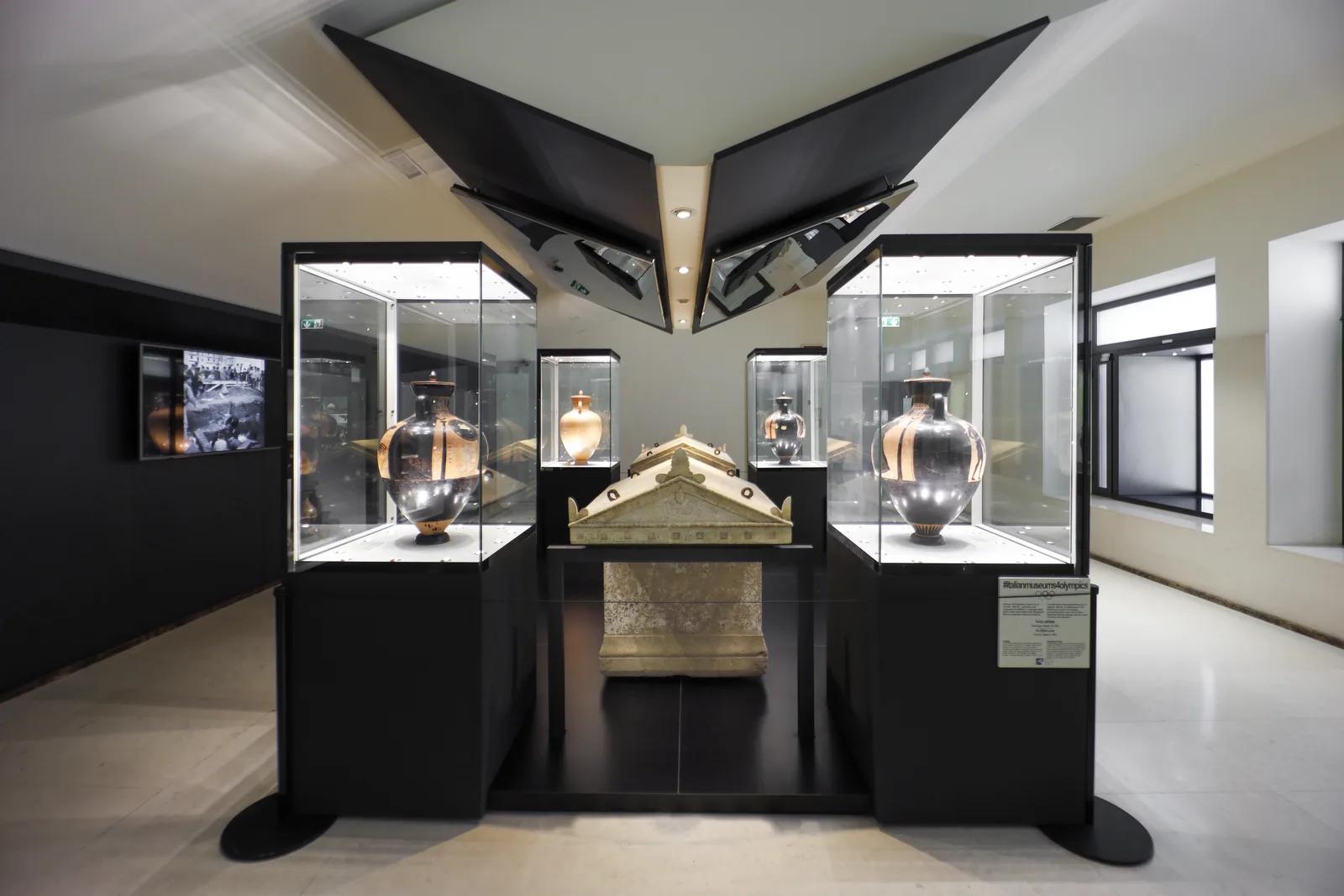
They are black-figure Panathenaic amphorae, attributed to the Kleophrades Painter and datable between 500 and 480 BC. These were not market vases: Panathenaic amphorae were filled with sacred oil from Attica and given only to the winners of the Great Panathenaea, the games Athens celebrated in honor of the goddess Athena. On one side they always show Athena armed between two columns; on the other, the winning discipline. On those from Taranto, we recognize boxing, chariot racing, and the pentathlon.
One of the four has reached us in fragments; the other three are intact and are now displayed in the cases around the sarcophagus. Whether those amphorae truly correspond to four Athenian victories or are rather the family's chosen way of declaring how much that man was worth, archaeologists still debate. Certainly, a man from Taranto returning from Athens with four prizes in hand is, for Magna Graecia in the 5th century BC, a minor celebrity.
The novelty of 2026 is that DNA was extracted from a tooth of that nameless man. The analyses, conducted by the Department of Biology and Biotechnologies "Charles Darwin" of Sapienza University of Rome together with the Institute of Molecular Biology and Pathology of the CNR, returned a surprisingly detailed identikit:
And then there is the detail that in Taranto sounds almost like a signature: in the dental tartar, traces of mollusk DNA were found. The athlete regularly ate seafood. Twenty-five centuries before mussels became a trademark of the city, its most famous champion was already feeding on what the sea put before him.
All of this is the heart of "The Art of Victory. Athletes and Competitions in the Mediterranean", the exhibition open at the MArTA from July 25, 2026, to January 10, 2027, created in dialogue with the Mediterranean Games and the LXV International Conference of Studies on Magna Graecia.
There are 53 artifacts on display, 36 of which come from the museum's storerooms and were restored for the occasion. The exhibition route was curated by director Stella Falzone, who worked based on research conducted since the 1990s by Enzo Lippolis and Antonietta Dell'Aglio, now updated with available analysis technologies. "The athletic gesture as an opportunity for encounter between different peoples and cultures in the sign of peace," is the formula with which Falzone presented the exhibition. Curators from Egypt, Tunisia, Morocco, and Tanzania, guests of the IV International School of Cultural Heritage, also collaborated on the project.
The most unexpected part, however, is the contemporary one. In a glass case in the hall, Taranto sports memorabilia are collected — cups, equipment, personal items — lent by the Triumphalia association and the Panathlon Club Taranto Principato: there is Erasmo Iacovone's jersey, there is Benedetta Pilato's 2020 European medal, there is Antonella Palmisano's Olympic gold in the 20 km race walk from Tokyo 2020. The 5th-century BC athlete and today's champions, in the same museum, at the same time the city is hosting the Games. Completing the route are an original drawing by Sal Velluto, a Taranto-born comic artist with a past at Marvel and DC, and the painted tiles by the Nasse Animation Studio, which is working on an animated short film dedicated to the Athlete.
For three evenings, the museum opens with extended hours, and the tomb becomes a stage. "The Athlete of Taranto" is a show conceived and directed by Massimo Cimaglia, with dramaturgy by Barbara Gizzi, produced by Terra Magica Arte e Cultura with the MArTA and the Games Organizing Committee. On stage, alongside Cimaglia, are Valeria Cimaglia and Marco Maggio, with live accompaniment on the harp by Benedetta Miro.
The mechanism is simple and beautiful: first, you visit the tomb in room VII, then the athlete takes voice and body, and tells "the fears, emotions, and enthusiasms that every sportsman experiences." For the foreign delegations and journalists who have arrived for the Games, accompanying slides are provided in English and French.
Entry to the show is free with mandatory reservation, upon purchase of the museum ticket and subject to availability. Reservations can be made at 099 4532112.
If you are already touring the city for the competitions, this is the detour that explains why Taranto wanted the Games in the first place: its first medal arrived two thousand five hundred years ago. You can find the museum described in the MArTA section, and the venues and schedule in the Venues and Competition Calendar sections.
Photos: Fabrizio Garrisi and Fabien Bièvre-Perrin, Wikimedia Commons, licensed under CC BY-SA 4.0.