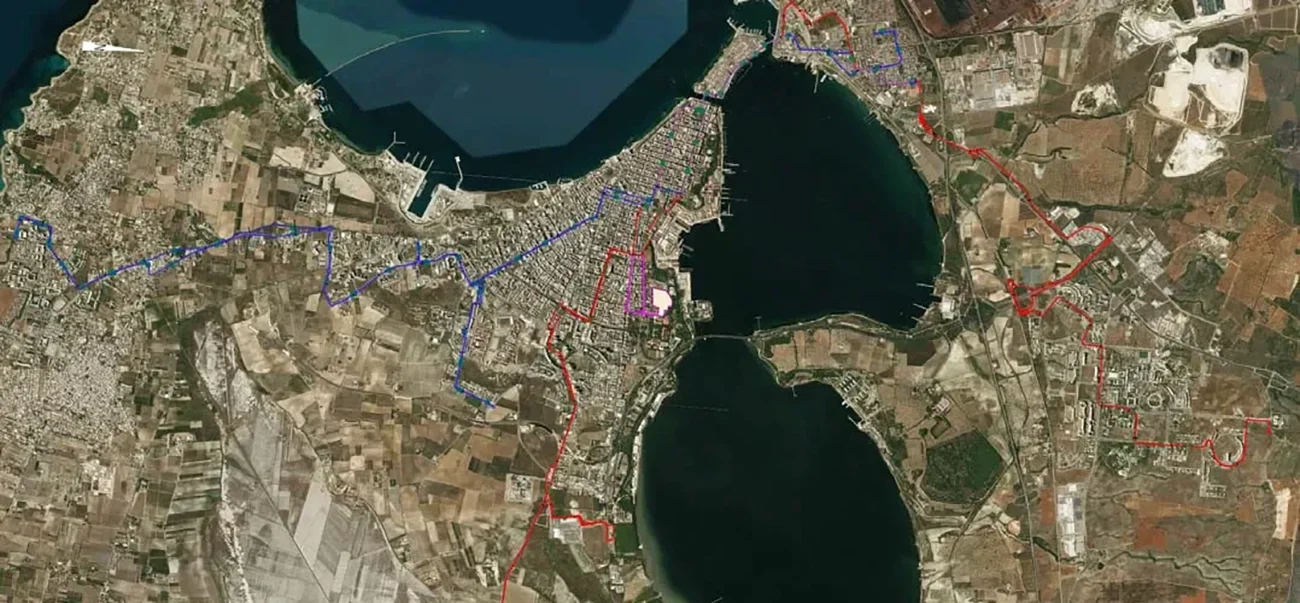
The Puglia Region has just concluded the negotiated procedure with the Municipality of Taranto for one of the most ambitious environmental projects ever funded in Southern Italy. 84 million euros from the National Just Transition Fund Program 2021-2027 are earmarked for the Green Belt of the Ionian city: this is not simply a planting plan, but a complex program of environmental, landscape and urban regeneration that promises to change the face of the city in the coming years.
Leading the project is the Regional Councillor for Landscape Marina Leuzzi, who coordinated the negotiated procedure together with the municipal administration of Taranto, in particular with Mayor Antonio Decaro and his council. The Municipality played a crucial role both in the application phase and in the subsequent negotiations, providing technical and administrative support to optimize the coherence of the interventions with the environmental and landscape objectives of the Puglia Region. The Region itself, through the competent department, supervised the entire process to ensure alignment with European Regulation 1991/2024 on nature restoration.
The negotiated procedure concluded with the approval of a project that goes beyond traditional urban green design to establish a new model of natural design. The 84 million euros funded will build a true urban ecological infrastructure capable of:
The specific interventions include:
According to Councillor Leuzzi, the project represents "a major urban and landscape stitching operation, capable of restoring continuity between neighborhoods, spaces and the relationship between the city and the environment".
For Taranto, this news marks a turning point in the city's environmental management. In recent decades, the Ionian capital has had to face significant challenges related to industrial pollution (the Ilva/Acciaierie d'Italia issue remains central to the local debate) and the degradation of many urban areas. An investment of this scale — among the largest ever allocated to an environmental project in Southern Italy — represents a concrete opportunity to regenerate entire neighborhoods and return usable and safe green spaces to citizens.
The program fits perfectly into the European ecological transition strategy and responds to current climate challenges: the creation of urban green infrastructure is recognized as a fundamental tool to reduce the heat island effect, improve air quality and increase the resilience of cities to climate change.
Beyond the environmental dimension, the urban planning and identity dimension also stands out strongly: the redevelopment of historic parks and coastal areas is not just a technical matter, but a stitching of the urban fabric that reconnects often isolated neighborhoods and restores dignity to degraded public spaces. For a city like Taranto, which has extraordinary landscape wealth (the Mar Grande, the Mar Piccolo, the surrounding natural areas), this represents an opportunity to transform the territory into an asset for quality of life and, potentially, for tourism and cultural attractiveness.
Now the operational phase begins. The coming months will be crucial for:
The issue of ordinary maintenance of existing green areas remains open: as a citizen noted on social media, areas like the Villa Peripato are in a deplorable state. It will be important that the new program does not divert resources from the care of the city's existing green heritage.
Other questions concern the implementation timelines (the JTF has strict deadlines, with 2027 as the horizon), the management capacity of the municipal administration and the involvement of local businesses in the works supply chain.
For those living in Taranto, this project represents a concrete sign that the city is not abandoned, but at the center of significant investments. What remains to be seen, as always, is the ability to turn projects into tangible and lasting realities.
Sources: TarantoSera, Puglia Region - Press release, IlikePuglia